
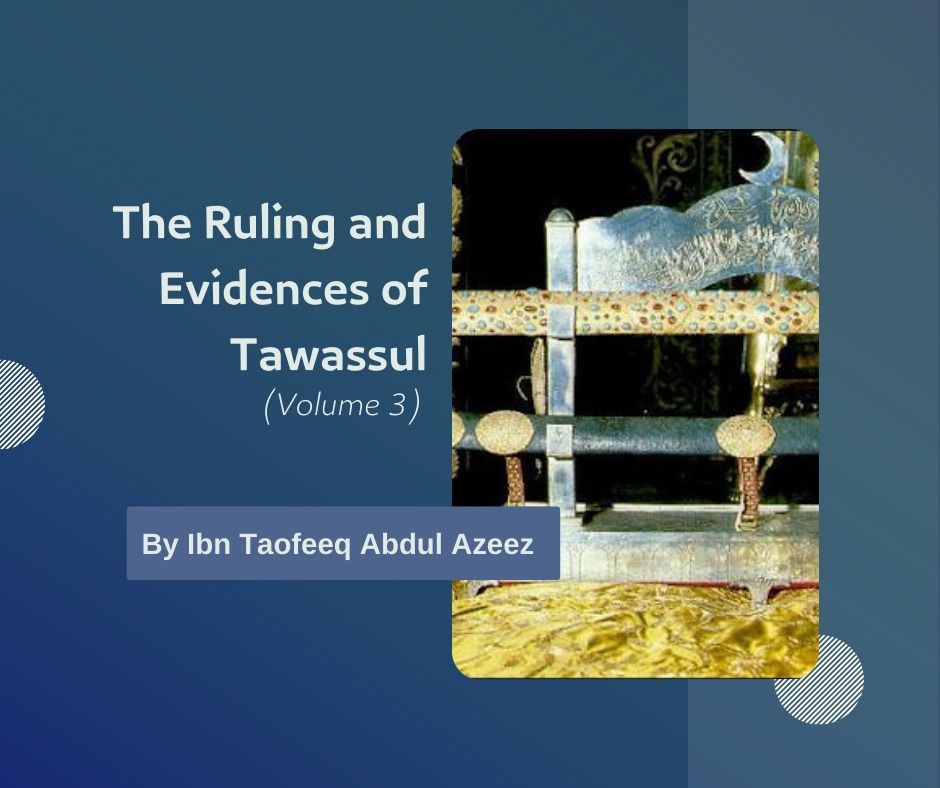
In another ahadeeth, the Prophet said:
من زارني بعد موتي فكانما في حياتي.
“Whoever visits my grave after my death, it is just the same as visiting me in my lifetime.” reported by Bayhaqi in Sha’b al-eeman no 4154
من جائني زاءرًا لا تهمه حاجة إلا زيارتي كان حقاً علي أكون له شفيعاً يوم القيامة.
“Whoever comes to me as a visitor and does not have any need (for his coming) except to visit me (my grave) then he has earned a right over me to intercede for him on the day of resurrection.” Tabraani 1349
Strangely, we find those who oppose At-Tabarani in this. At-Tabarani is from the Salaf, a Taabi Taabi’een (3rd of the best generations). He was born in 260H and died in 360H. So, you who antagonises this with the sayings of Ibn Taymiyyah, Ibn Qayyim, Al-Albaani, Ibn Baaz, Ibn Uthaymeen, all of these personalities are not from the Salaf and you are quick to quote ‘عليكم بسنتي و سنة خلفاء الراشدون’, insisting upon our following the Prophet and the Salaf and yet takes the words of Ibn Taymiyyah and Al-Albaani over their own sayings and actions.
They whom at their time, the teachings of the Deen have not been diluted and Allah and the Prophet mentioned their virtues and merits and ensured our guidance if we follow them as their sayings and actions are backed by the Qur’aan and Sunnah. How then is it that we should take the explanations of those who came much later in the 7th, 8th century hijrah, or Muhammad bn AbdulWahhab, who came in the 12th century. He was born in 1115H and died in 1206H. How should we take these modern strange opinions over the explanations of the السابقون الأولون!
May Allah rectify our affairs.
From the sayings of the Prophet is also
من حج فزراني في مسجدي بعد وفاتي كان كمن زارني في حياتي.
“Whoever performs Hajj and then visits me (my grave) in my Mosque (Masjid An-Nabawi) after my death, he is like the one who visits me during my lifetime.” Darqutuni 192, Bayhaqii 10054
There are other riwaayaat without the لفظ pronunciation of Hajj and they simply mention visiting the Prophet’s mosque.
There are many more ahaadeeth on the virtue of visiting the Prophet’s grave and Masjid An-Nabawi which we cannot quote in this short presentation.
There are two important matters worthy of mention. One of them is وجوب التعظيم النبي و رفع رتبته عن سائر الخلق
(The obligation of exalting the Prophet and his elevated rank over the rest of creation). The Prophet is not one to be belittled. He is honourable, beloved respected.
The second matter is إفراد الربوبية و الاعتقاد أن الرب تبارك و تعالى منفرد بذاته و صفاته و أفعاله عن جميع خلقه (In belief, It is Allah that one calls upon as beseeches and is transcendent in His essence, attributes and actions over His creation). That we use a person as a means to reach Allah does not mean that we attribute what is specific and exclusive to Allah to the intermediary.
Let us now talk about the ruling of Tawassul.
There are part of the details of tawassul which are explicit and there is unanimous consensus about them. For example,
1) using our eemaan and 2) our good deeds.
There are other details which are not so explicit and bring about differences of opinion. From them,
1) opinions that it is reprehensible to supplicate with the virtue/honour of the Prophet.
2) opinions that say that we can supplicate by the virtue/status/honour (بجاهه) of the Prophet ﷺ only whilst he was alive and it is impermissible after his death.
Let us look at some ahaadeeth to highlight the ruling of Tawassul.
The ruling is that it is permissible and even Sunnah. A point to note here is that those who pronounce tawassul as being impermissible are the ones who violate tawheed. Their equating making tawassul with the Prophet to asking him directly to fulfill a need suggests that their Aqeedah (creed) has loopholes and their tawheed is shaky. This is because the fundamental creed of a Muslim is that Allah is the fulfiller of needs and granter of request.
From the many ahaadeeth which establish tawassul, is a well-known one which shows the Prophet’s ﷺ own practice while making Dua.
The Prophet would say, “Allahumma inni as’aluka bi haqqi saa’ileen ‘alayka…(Oh Allah, I ask You by the right/virtue/status of those who ask You i.e the believers”. Tawassul started with the Prophet himself.
The Prophet enjoined some of the Companion to make this Dua e.g Bilal, Abu Sa’eed Al-Khudri.
حدثنا محمد بن سعيد بن يزيد بن إبراهيم التستري حدثنا الفضل بن الموفق أبو الجهم حدثنا فضيل بن مرزوق عن عطية عن أبي سعيد الخدري قال قال رسول الله صلى الله عليه وسلم من خرج من بيته إلى الصلاة فقال اللهم إني أسألك بحق السائلين عليك وأسألك بحق ممشاي هذا فإني لم أخرج أشرا ولا بطرا ولا رياء ولا سمعة وخرجت اتقاء سخطك وابتغاء مرضاتك فأسألك أن تعيذني من النار وأن تغفر لي ذنوبي إنه لا يغفر الذنوب إلا أنت أقبل الله عليه بوجهه واستغفر له سبعون ألف ملك
On the authority of Abu Sa’eed al-Khudri who narrated that the Prophet said: “The one who leaves his house for prayer and then says: O Allah, I ask you by the right of those who ask you and I beseech you by the right of those who walk this path unto you, that my going forth bespeak not of levity, pride nor vainglory nor done for the sake of repute. I have gone forth in the warding off your anger and for the seeking of your pleasure. I ask you, therefore, to grant me refuge from Hellfire and to forgive me my sins, for no one forgives sins but yourself. Allah will accept for his sake and seventy thousand angels will seek his forgiveness.”
أخرجه ابن ماجه في سننه برقم: ٧٧٨
Shaykh Mamdoh in his monograph refuted the reasoning of Sheikh al-Albaani and Hammad al-Ansari in declaring this hadïth weak.
Another hadeeth evidence is the action of the Prophet when the mother of Ali ibn Abi Taalib, Fatima bint Asad died.
It is narrated by Anas bn Malik. He said: When the mother of ‘Ali bn Abi Talib — Fatimah bint Asad bn Hashim — died, Allah’s Messenger called on her and sat down by the head of the bed and said, “O dear mother, may Allah have mercy on you. After my mother, you were the one I regarded as my mother. When I was hungry you fed me to the point of saturation while you yourself remained hungry. Then you helped me put on clothes and instead of eating yourself, you gave me nice things to eat. You did all this for Allah’s pleasure and for a good reward in the Hereafter.” Then he (the Prophet) commanded to bathe her three times. When camphor water was brought, Allah’s Messenger poured some water into his hands. Then the prophet took off his shirt and clothed her with it and used his own sheet of cloth as her coffin. Then the prophet sent for Usamah bin Zayd, Abu Ayyub al-Ansari and ‘Umar bin al-Khattab and the negro slave to dig up the grave. So they dug her grave. When they reached near the lahd, the prophet dug it up and drew the soil out with his own hands. When he finished, the Prophet entered and lay down in (the grave), and said, “Allahul-ledhi yuhyee wa yumeet ighfir li ummi (Fatima bint Asad) wa laqinnaha hujjatuha wa wassi’i ‘alayha mudkhalaha bi haqqi nabiyyika Wal anbiyaa’i min qabli fa innaka arhamu rahimeen {It is Allah Who controls life and death, and He is Ever living and will never die. (O Allah,) forgive my mother—Fatimah bint Asad— and help her answer properly at the time of questioning and through the mediation of Your Prophet (Muhammad) and the earlier prophets, make her grave capacious. Surely You are infinitely Merciful}.” Then he repeated, “God is Great” four times (i.e. led the funeral prayer). Then he, ‘Abbas and Abu Bakr as-Siddiq lowered her into the grave.
[Ref: Tabarani in Mu’jam Al-Kabir: 871, Tabarani in Mu’jam Al-Ausat Vol 1 Hadith 189, Hilyatul Auliya(3:121)]
This narration is classified as authentic according to the standards of Imaam ibn Hibban and Haakim:. [Raf’ul Manaarah pg.147; Maqaalaatul Kawthari]. Haafiz Ibn Hajar Al-Haytami:Majma‘-uz-zawā’id (9:256-7). He states that its chain of narrators is good [Refer to his footnotes on Al-Manaasik of Imaam Nawawi pg.500…]
Sheikh Mamdoh noted that although Sh. Albaani in his Silsila Da’ifah (1:32-33) claims it is a case of explicated discreditation (jarh mufassar) yet he himself declares identically-formulated discreditation cases as unexplicated and therefore unacceptable in two different contexts! Ibn ‘Alawï adds that the hadïth is also narrated from Ibn ‘Abbas by Ibn ‘Abd al-Barr and from Jabir by Ibn Abi Shayba.
Imam al-Kawthari said of this hadith in his Maqalat (p. 410): “It provides textual evidence whereby there is no difference between the living and the dead in the context of using a means (tawassul), and this is explicit tawassul through the Prophets, while the hadith of the Prophet from Abu Sa’id al-Khudri ‘O Allah, I ask You by the right of [the promise made to] those who ask You (bihaqqi al-sa’ilina ‘alayk)’ constitutes tawassul through the generality of Muslims, both the living and the dead.”…
In another hadith:
From Uthman bn Hunayf, that a blind man came to the Prophet and said: “I’ve been afflicted in my eyesight, so please pray to Allah for me.” The Prophet said: “Go make ablution, perform two rak’ah of prayer, and then say:
“Allahumma lnni as’aluka wa atawajjahu ilaika bimuhammadin nabiyyir-rahma. Ya Muhammadu inni qad tawajjahtu bika ila rabbi fi haajati hadhihi lituqda. Allahumma fashaffi’hu fiya (O Allah, I ask of You and I turn my face towards You by virtue of the intercession of Muhammad the Prophet of mercy. O Muhammad, I have turned to my Lord by virtue of your intercession concerning this need of mine so that it may be met. O Allah, accept his intercession concerning me)”.
This hadith has been reported by Tirmidhi, al-Hakim in his Mustadrak and Nasa’i, ‘Amal-ul-yawm wal-laylah, and it is from the hadith of Uthman bn Hunaif radiya Allahu anhu. Imam Ahmad also narrated it with a sound narration. Imam Hakim in his mustadrak stated that it is authentic according to the criterion of the Imam Muslim and Imam Bukhari and his narration had the addition: “so he supplicated with this Dua and he arose and was able to see.”
The hadith explicitly proves the validity of supplicating Allah (tawassul) through a living intermediary, as the Prophet was alive at the time. As well this hadith implicitly shows the validity of supplicating Allah (tawassul) through a deceased intermediary as well, since the Prophet told the blind man to perform ablution, pray two rak’ah, and then make the supplication containing the words, “O Muhammad, I seek your intercession with my Lord for the return of my eyesight,” which is a call upon somebody physically absent, a state of which the living and the dead are alike. He made the solaat and prayer in the absence of the Prophet.
Another hadith is that which Tabarani, in his “Mu’jam As Sagheer Volume 1 Page 306-307, Hadith number508”, the hadith of Uthman bn Hunayf that a man repeatedly visited Uthman bn Affan radiya Allahu anhu concerning something he needed, but Uthman paid no attention to him or his need. The man met Ibn Hunayf and complained to him about the matter – this being after the death (wisal) of the Prophet and after the caliphates of Abu Bakr and Umar – so Uthman ibn Hunayf, who was one of the Companions who collected hadiths and was learned in the religion of Allah, said:
“Go to the place of ablution and perform ablution, then come to the mosque, perform two rak’as of prayer therein, and say:
‘O Allah, I ask You and turn to You through our Prophet Muhammad, the Prophet of mercy; O Muhammad (Ya Muhammad), I turn through you to my Lord, that He may fulfill my need, and mention your need. Then come so that I can go with you [to the caliph Uthman].”
So the man left and did as he had been told, then went to the door of Uthman ibn Affan and the doorman came, took him by the hand, brought him to Uthman ibn Affan, and seated him next to him on a cushion.
‘Uthman asked, “What do you need?” and the man mentioned what he wanted, and Uthman accomplished it for him, then he said, “I hadn’t remembered your need until just now,” adding, “Whenever you need something, just mention it.”
Then, the man departed, met Uthman ibn Hunayf, and said to him, “May Allah reward you! He didn’t see to my need or pay any attention to me until you spoke with him.”
Uthman ibn Hunayf replied, “By Allah, I didn’t speak to him, but I have seen a blind man came to the Messenger of Allah and complained to him of the loss of his eyesight. The Prophet told him to do what I told you to do.
This is an explicit, unequivocal text from a prophetic companion proving the legal validity of tawassul through the dead. The account has been classified as rigously authenticated by Baihaqiy in Dalail An nubuwwah Vol 6 Pg 167-168, Mundhiri At-Targheeb wa Tarheeb, Pg No 129, Haythami, Tabrani, amongst others.
Ibn Taymiyyah also declared it “saheeh” in his Qa’ida al Jaleela fit Tawassul wal Waseela (Pg No. 156). Only that he explained it away.
We continue this discussion in the 4th Volume.
Original and full audio of this lecture in yoruba language can be found in our Halqah Facebook group below:
https://m.facebook.com/groups/1219889145143341/permalink/1280961869036068/
Transcribed by: Ogundele, AbdulQayyum Afolabi