
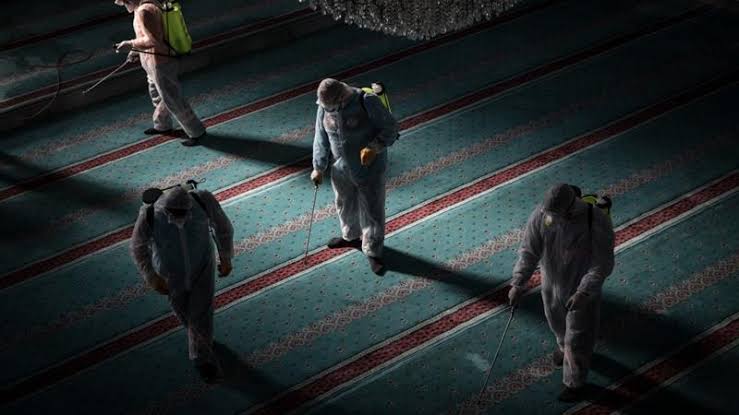
Health professionals around the world have become concerned with the spread of the dangerous infectious Coronavirus.
Therefore, experts are advising the public to keep a distance from people of at least two metres. They also warn us that the virus could stay dormant within us from days to weeks. This is why entire countries or cities are on lockdown currently around the world, and why events and gatherings are being cancelled widely.
Due to the nature of our communal worship – especially in regards to physical and social contact – the Muslim practice of gathering for communal prayer calls for a more pressing ruling than general gatherings for events in the greater community.
During prayer itself, people stand in close proximity, shoulder to shoulder, and make sujud, breathing out on to the carpet which then another person will touch and breathe in. We reflexively shake hands and hug each other – habits we have been conditioned to do for years!
Islam teaches us that we are to utilize all methods to prevent the spread of diseases which endanger lives and compromise human well-being.
The Prophet established the principle of quarantine when he said, “no person who is afflicted with a communicable disease should be brought near the healthy.”
He also advised us to keep away from those with disease. When a person with leprosy wanted to give the Prophet an oath of allegiance, the Prophet solla Allahu alayhi wa sallam did not shake hands with him. Rather, he assured him gently, he said: “We have already received your oath of allegiance, so go back“ according to the report narrated by as-Shareed ibn Suwayd ath-Thaqafi. Which indicates not shaking of hands at this present time is also a sunnah of the Prophet solla Allahu alayhi wa sallam.
The basic ruling even when there is no mosques shut down is if anyone fears that he may be harmed or may harm others, it is permissible for him not to attend the jumu’ah prayer and prayers in congregation, because the Prophet said: “There should be neither harm nor reciprocating harm.”
It is even worth remembering that the Prophet advised those who consume garlic to stay away from prayer gatherings until they got rid of the foul smell. He thus taught us to refrain from all activities that are offensive to others.
If this was his advice even on scents that may be bothersome, we can rest assured that in the event of an infectious disease such as this global pandemic of COVID-19, we are to refrain from bringing the potential for harm into our gatherings.
A far more relevant incident to cite is the story of Umar bn Khattab radiya Allahu anhu. He was on his way to enter Shaam when he heard that it was infected with cholera, he refused to enter the city and decided to return to Madinah. When Abu Ubaidah asked him, “Are you fleeing from the decree of Allah?”
Umar replied, “Not at all; instead, we are fleeing from one decree of Allah to another!”
Then Umar asked, “If you were to take your herd away from a drought stricken to a fertile valley, aren’t you complying with the decree of Allah?”
Umar was teaching us that accepting the will of Allah does not in any way contradict the human will and freedom to work to realize goals that are beneficial, nor to prevent any harm that he or she anticipates.
Additionally, the Prophet already set the precedent of canceling congregational prayers during natural phenomena such as heavy rain or storm or flooding. The Prophet said, “Where there is a tangible harm, it ought to be removed.”
Furthermore, the Shari’ah permits someone who is threatened with death to renounce his faith to save his life as long as he or she still cherishes faith in the heart. This underlines the priority of the sacredness of life over the practice of outward expressions of faith.
Islam is a religion that teaches social responsibility and care for humanity – both in our local communities and in a global context.
Muslims ought to temporarily cancel all congregational prayer gatherings, including Jumu’ah, as well as other meetings and conferences until experts advise us that the risks have passed. This prevents harm to our communities and the greater society and world we live in.
Also, a great sahabiy – Muadh bn Jabal radiya Allahu anhu passed away when Amuas plague broke out during the reign of the second Caliph, Umar, may Allah be pleased with them all. This plague claimed the lives of many of the Prophet’s Companion. Muadh was one of these martyrs.
Infection control in Islam includes isolation and quarantine. People who are infected are quarantined, and if they were to die, funeral rites such as bathing and shrouding could not be performed in the usual way.
Therefore, the situation is grave in every sense, and hence the need for a strict ruling regarding Jumu’ah.
As for those who are emotional about the issue and claiming mosques are the place to seek Allah’s mercies over such epidemic, I believe none of them will deny hajj being an article among the pillars of Islam, this same COVID-19 has put a pause on hajj and umrah, and those who will pass on next year who intend fulfilling hajj this year will not have the privilege of fulfilling the rites of Allah. With their sincere intention, we hope Allah will reward them the reward of those who fulfilled hajj. Same thing to be said to our solaat at home in this present time, we hope Allah reward us with the reward of jamaa’ah.
Some Muslims also asked about the ruling of following a prayer by listening to the radio, the direct answer to this is that whoever wants to pray in congregation has to be in congregation or go to the mosque, because if he follows the imam in his home this is not prayer in congregation,
To fulfill solaat jamaa’ah, two conditions must be met:
1 – That he can hear the takbeer
2 – That he can see the imam or the congregation, either throughout the entire prayer, or for part of the prayer. And the rows of worshippers must be uninterrupted as said by Imam Quddaamah in his Mughni.
Lastly, During this time of difficult trials, we must pray with increasing devotion and sincerity for sound health and protection from the Healer, the Curer, and the All-Compassionate and All-Merciful.
Suratu Yunus, Verse 107:
وَإِن يَمْسَسْكَ اللَّهُ بِضُرٍّ فَلَا كَاشِفَ لَهُ إِلَّا هُوَ وَإِن يُرِدْكَ بِخَيْرٍ فَلَا رَادَّ لِفَضْلِهِ يُصِيبُ بِهِ مَن يَشَاءُ مِنْ عِبَادِهِ وَهُوَ الْغَفُورُ الرَّحِيمُ
And if Allah should afflict you with harm, then there is none to remove it but He; and if He intends good to you there is none to repel His grace; He brings it to whom He pleases of His servants; and He is the Forgiving, the Merciful.
6 Responses
Excellent piece. May Allah bless your pen.
Jazaakumullahu khayran
Jazakallau khayran for your effort.
But there are other opinions by some scholars of Islamic jurisprudence.
During d plague dt occurred at d time of Umar bn Khatab(RA) congregational prayers were not stopped or prohibited
We have presented what seems the most correct of the opinions – and Allah knows best. That is not the only evidence pointed out in the article.
Well done for the information
And even at that, it was Syria that was afflicted at that particular time. With the effect of globalisation and aviation that makes travelling easier and faster, the Corona Virus Disease has been declared by WHO as a global pandemic. It started in China and in less than two months it is in 167 countries.
If the prophet ordered the maudlin to proclaim “pray un your homes ” instead of “come to salat” for heavy rain, if the rain persist the order will persist.
Brother IbnTaofeeq Jazakumullahu khayran kathiran.