
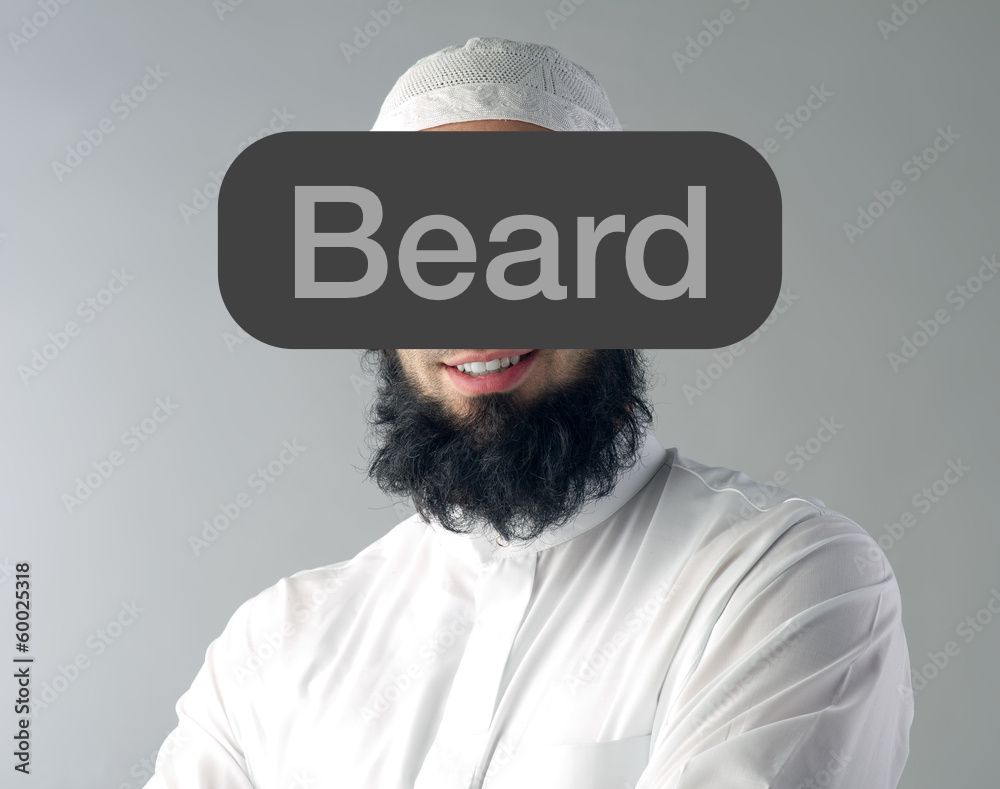
Yet another controversial issue among Muslims today is the issue of keeping, shaving or trimming of the beards. Some have been considered ahlu bid’ah (innovators) for shaving or trimming their beards; while others have been seen as Sunnis for keeping their beards. Likewise some Muslims disregard growing of the beards as part of Islam. Are these notions correct? What is the exact Islamic ruling as regard beards? Can we observe our solaat behind an Imam who shaves or trims his beard? Will the person who trims or shaves his beard be automatically regarded as an innovator (mubtadee’) while the one who keeps it automatically becomes a Sunni upon the right faith? These among others are the cogent points this chapter discusses.
Unequivocally, our first issue with the topic of growing or trimming of the beards is the meaning of beards and its limit. While some defined beards to mean the hairs that grow on the entire face, some linguists consider what grows on the chin only as the beards; and some regard what grows on the chin and cheeks only as the beards.
The Definition of the Beard:
Linguistically, the beard refers to the hair that grows on the cheeks and the chin. It is referred to as al-lihyah (singular) and al-lihā or al-luhā (plural). Al-lahyi is a reference to the jaw bone which is called al-lahyiyain (in dual form) because they are the two bones that hold the teeth of humans and animals — and it is the skin that covers the entire jaw bone upon which the beard grows.
See Lisān al-Arab Vol. 15 pg 243, Mukhtār as-Sihāh pg 248, Al-Misbāh Al-Muneer pg 2551 for this definition.
The limits of the Beards:
The scholars hold that the beard is the hair which grows on the cheeks and the chin – that is the beard. As for that which grows on the throat or neck, that is not referred to as a beard (al-lihyah). Likewise, whatever is above the bone adjacent to the ear, this is considered as part of the head (i.e. the temple region) and is not from the beard. The beard is that which grows on the two cheeks below that bone that is adjacent to the ears, and that which grows on the chin, and the hair which grows beneath the bottom lip which is called al-‘anfaqah (which is the small tuft of hair in the middle under the lower lip), this too is from the beard. Likewise the hair that grows on the throat and neck is not considered to be the beard.
The beard is among the Sunan al-fitra:
The beard is a part of the male anatomy which beautifies, gives respectability and adorns the man. (That is only when it is kept in good trimming).
The beard is a natural inherent part of the biological characteristics of the male gender of the human being; its purpose is to differentiate between the male and the female. It is a sign of manhood, distinction from femininity and a sign of adulthood in males. This conclusion is also derived by logical reasoning and intellect.
In answer to the supplication made by our grandfather Adam (alayhi salaam), Allah made the growth of the beard an in-built natural feature of the male, and a feature which will continue being such till the day of reckoning.
Sheikh Majlisi (rahimahu Allahu) quotes in a narration, in Vol. 16 of his book Bihar Al-Anwar (Seas of Illuminations) on the authority of Ibn Mas’ood in which the Prophet solla Allahu alayhi wa sallam states:
“When Allah, the Blessed, the Merciful, accepted the repentance of Adam, Jibreel alayhi salaam came to Adam and said, “May Allah grant you a (long) life and bestow beauty upon you” Adam then said, “I understand what you mean by long life, however, I do not understand what you mean by beauty”
[Thus, in thanking Allah,] he went into prostration and when he raised his head from it, he made a supplication and said, “O Allah, Increase in me the beauty [that you have promised me]”, soon after he had made the supplication, a beautiful beard appeared on his radiant face. When Jibreel witnessed what had happened, he touched the beard of Prophet Adam and said, “This is in response to the supplication you made to your Lord, and it has been granted to you and your male offspring till the day of reckoning”.
Also, the famous hadith of Aaisha and Abu Hurayrah (ridwaanu Allahi alayhim) which states that the beard is among the primordial states (sunanul fitra). Imam Muslim reported on the authority of Aaisha that the Prophet said:
“Ten things are from the primordial state (fitra): clipping the mustache, keeping the beard, using the tooth stick, snuffing water and expelling it from the nose to clean it, trimming the nails, cleaning the knuckles, plucking out underarm hair, shaving pubic hair, and decreasing the amount of water used.” Some of the narrators said, “And I forgot the tenth, which is rinsing the mouth with water.”
The Ruling of Keeping the Beards:
The command for keeping the beard has come from various hadith such as:
“خالفوا المشركين، و فروا اللحى و أحفوا الشوارب”
Meaning: “distinguish yourself from the disbelievers, keep your beards and shorten your moustaches.”
The jurists have disputed the nature of the command in this hadith, is the command used for an obligatory act, or a recommended act? The majority of jurists have ruled that it is obligatory (waajib), but the jurists of the Shafi‘i school have ruled that it is recommended (manduub).
The Shafi‘i jurists have dealt with this issue extensively such as Imam Zakariyya al-Ansari who stated, “it is reprehensible (makrooh) to pluck out ones facial hair once it grows it being preferable for it to grow giving one a noble face.”
Imam al-Ramli has commented on this sentence by saying, “his statement ‘it is reprehensible to pluck out…’ meaning the beard and likewise shaving it. Therefore the statement of al-Hilmi in his Minhaj that it is impermissible to shave the beard or the eyebrow is weak.”
Imam Ibn Hajar al-Haytami has stated, “Concerning the beard, there are actions which are considered reprehensible (makrooh) such as plucking it, shaving it, as well as the eyebrow.” This has been confirmed by Imam Ibn Qasim al-‘Ibadi in his book on Tuhfat al-Muhtaj in which he states, “Our teachers have stated that shaving the beard is reprehensible (makrooh).”
The noble scholar al-Bujayrimi has stated in his book on al-Khatib’s commentary that, “shaving the beard is a reprehensible (disliked) act even from a man and it is not prohibited.” The reason he stated “even from a man” is not to be in contradistinction from a woman, but rather it is in contradistinction to a young man as the original discussion revolves around the ruling of a shaving once the facial hair has come in, i.e. in a young man. The discussion follows that the initial growing of the facial hair is not a condition, and a grown man shaving his head also falls into the ruling.
The reprehensibility (karaa-ah) of shaving the beard is not just found amongst the Shafi‘i school. We find that Imam al-Qadi ‘Iyad from the Maliki School has stated that, “it is disliked (makrooh) to shave the beard, pluck it, or burn it.”
As for those jurists who argued that keeping the beard is mandatory, they have taken another meaning from the aforementioned hadith and other related ones. They are of the opinion that shaving the beard is a negative trait, and goes against the general appearance of a man during their times giving him a certain measure.
Imam al-Ramli has stated in his discussion of castigation (ta’zir) that it should not be done by shaving a man’s beard as this is a form of deformation and his children will also be shamed by this.”
In fiqh (legal matters), if a command (amru) is attached to a custom, the command changes from obligation (waajib) to recommendation (mandoob) and this is attested to in many instances where jurists have taken hadith with clear commands but their commands were understood to be recommended acts not obligatory ones. An example of this is the hadith, “Change your grey hairs so you do not imitate your enemies, and the best change is henna and concealing.” As changing or altering one’s grey hair or not is not considered a negative act in society, the jurists have understood the command to be a recommendation and not an obligation.
Accordingly have Muslim jurists dealt with such issues. Jurists of the past used to consider anyone who wore Western clothing as leaving Islam. However, when this practice became widespread and commonplace amongst Muslims, they changed their opinions.
Therefore, the ruling concerning the beard during the time of the pious ancestors, during which both Muslims and non-Muslims used to keep their beards, was one of dispute with the majority of jurists saying it was mandatory to keep the beard and therefore prohibited to shave it and the Shafi‘i jurists who said shaving the beard was reprehensible as keeping it was only a Sunnah practice.
Accordingly, we rule that especially today when customs have changed, we must checkmate our sincerity (ikhlas) and intention while keeping our beards to grow. And the opinion which states that shaving the beard is a reprehensible act (makrooh) and keeping it is a Sunnah act that entails praise and reward as long as one keeps it well and is presentable, this is also a valid opinion.
Trimming of the beards:
Trimming the beard is a Sunnah. The Prophet (solla Allahu alayhi wa sallam) used to trim his beard and cut some of its sides and the top portions in order to match the contour of his face in order to go well with his overall appearance. He also used to wash his beard with water and comb it. It is also known that the Companions of the Prophet followed him in his actions and decisions.
As for trimming the beard in a fashionable way, this depends on the customs and traditions prevailing in the community. This means that there is no objection in Shari’ah (Islamic law) to do this so long as it is a familiar form of customs and traditions and it does not include imitating immoral people.
Shaving of the beard and the ruling of a barber who shaves:
Shaving the beard is one of the issues over which there is a scholarly debate on as said earlier. While the majority of scholars maintain that shaving the beard is unlawful, the Shafi’is maintain that it is disliked. They base their opinion — that it is recommended to keep the beard and refrain from shaving it — on their understanding of the command pertaining to customs; food and drink; clothing; sitting; and appearance; and used the examples of the command to dye one’s hair and pray in one’s footwear and the like to substantiate their opinion.
The same applies to threading the face; scholars differ on whether removing hair other than that of the eyebrows is considered nams [Plucking facial hair and eyebrows] which is prohibited in the Shari’ah. This is because the opinion of some scholars from the different schools of jurisprudence and the established opinion of the Malikis is that plucking facial hair other than the eyebrows is permissible and entails no prohibition — unlike the majority of scholars who maintain that it falls under “nams” which one is warned against in the noble hadith.
The Islamic legal maxim states:
- Objection is reserved for omitting what is agreed upon by scholars to be a requirement, and performing something that is agreed to be unlawful.
- Objection is not for issues where there is a difference of opinion.
- It is preferable to remove oneself from controversial issues.
- Whoever is afflicted with something controversial may follow the opinion of the scholar who permits it.
Based on this and in reference to if a barber can shave the beard when asked to, there is no harm if you shave the beards or thread the faces of those customers who ask you to do so as long as you follow the opinion of the scholars who permit it, especially since you have no other work; you are only carrying out your work. Therefore the money you earn from your work is, by the will of Allah, lawful. Though we advise you to refrain from shaving beards and threading faces as much as possible.
Praying (solaat) behind an Imam who shaves his beard:
Imam Al-Bukhari narrated that Abdullah Ibn Umar prayed behind Al-Hajjaj bn Yusuf Al-Thaqafi and Abdullah Ibn Mas‘ud prayed behind Al-Walid Ibn Uqba bn Abu Ma‘it who used to drink alcohol. Al-Walid once led the Morning Prayer and performed four rak’ah instead of two.
The Companions also used to pray behind Ibn ‘Ubayd who was accused of atheism and of calling the people to error. So [if these people could lead prayers], a fortiori anyone who knows how to pray.
There is no doubt that it is more advantageous to pray behind a righteous person rather than behind someone who is corrupt. Yet, even if the behavior of an officially recognized prayer leader is suspect, there is no proscription in Islamic law which forbids praying behind him. However, it is obligatory to advise him [to mend his ways].
[In this respect] Ibn Majah and Ibn Haban recorded the following narration: “There are three whose prayers will not be accepted: an imam who is unpopular [because of his conduct]; a woman who allows her husband to wake up [the morning after an argument] while he is still angry with her and two brothers when they are fighting.”
Although it is disliked to pray behind a corrupt person, it is not unlawful. In addition to the above, this is supported by the hadith: “Pray behind the trustworthy and the corrupt, and perform jihad with the trustworthy and the corrupt” [recorded by Al-Bayhaqi].
Shaving the beard is not a grave sin for a man. Rather, it is among the [many] matters upon which the scholars have not reached a unanimous agreement on whether they are obligatory or merely recommended.
According to the basics of Islamic law, a matter upon which the scholars disagree may not be generally prohibited for Muslims. The Imam who shaves his beard should not be avoided and it is permissible to pray behind him. He is not to be compared with the one who drinks alcohol and fornicate and other grave sinners.
Conclusion:
There is scholarly difference over keeping a beard.
From the matters that are confirmed throughout Islamic law is that keeping of the beard and refraining from shaving it are from the acts of the Prophet which all Muslims should strive towards. He used to trim his beard and trim its sides and top portions in order to match the contour of his face. He also used to wash his beard with water and comb it.
It is also known that the Companions of the Prophet emulated his actions and decisions.
There are Prophetic texts that support keeping and maintaining the beard just as there are texts that support the use of the tooth stick (siwak) and cutting one’s nails and mustache.
Some of the jurists have taken these texts to mean that these actions are obligatory, and according to this opinion, shaving the beard would be prohibited.
Other jurists have taken these texts to mean that these actions are recommended, and according to this opinion, keeping of the beard is a Sunnah; one is rewarded for keeping it and not punished for leaving it.
As for the first opinion that prohibits shaving the beard, the text proofs used are the ones encouraging Muslims to grow their beards to distinguish themselves from disbelievers.
As for the second opinion, it is the opinion of Shafi’i scholars who maintain that shaving the beard is not prohibited. They based their opinion on their understanding of the command related to customs, food, drink, clothing, sitting, etc. which is understood to be a recommendation and not an obligation. They used the examples of the command to dye clothes and to pray in sandals to prove that these are not commands imposing obligation, but rather recommendation as Ibn Hajr al-Asqlani mentions in his commentary on Sahih Bukhari.
As mentioned above, the Prophet used to trim his beard and clip its sides. Some scholars permit trimming off the hair of the beard that exceeds the amount that may be grasped in the fist because this was the practice of Ibn ‘Umar.
The most important thing about keeping a beard is to maintain good appearance so as not to give a bad impression about Muslims.
Based on this, it is clear that there is a legitimate scholarly debate concerning the ruling of keeping the beard. When there is a scholarly difference of opinion concerning a certain issue, it is preferable to avoid it. But if this is not possible, Muslims are to follow the scholars who permit it. Therefore, it is permissible to keep a beard, and may not be an obligation, and let it grow to fist length following the example of Ibn ‘Umar.
Written October 2020