
There are some opinions we (ignorantly) brand those who do not subscribe to as deviants, ahlul bid’ah – and mostly are issues usually based on narrations that could still be disputed because of its susceptibility to speculation. If a Muslim disagrees based on other scholastic facts which supersede the solitary nature of the common opinion, it does not make the Muslim a deviant or mubtadee'(heretic and innovator) because neither the Qur’an nor authentic hadeeth give such uniformed details.
That is why the verifying scholars of sunnah opine that solitary hadith(khabar ahad) cannot be used to establish aqeedah as it is subject to criticism and rejection if subjected to rigorous analysis.
What is popular in common books is that whoever believes the Prophet(solla Allahu alayhi wa sallam) was not enchanted is branded a deviant, mubtadee’, which should not be so. It is a common erroneous perception. Fine, you can hold to the believe that the Prophet was enchanted while I hold to the scholastic opinion that he wasn’t enchanted, why should I be considered deviant and heretic for an opinion that I can prove with the Qur’an, sunnah, narrations from the salaf and later scholars of sunnah?! Not agreeing does not amount to deviancy. This is one of the major points this article is to re-addressed.
The hadeeth in Saheeh Bukhari which says the Prophet was enchanted by a Jewish sorcerer is undoubtful authentic in its isnad, so there is no need for anyone to castigate Imam Bukhari for that or cast doubt in the entire hadeeth institution, but let us look beyond the common matn(context) of this same hadeeth with other authentic narrations and evidences.
The issue of the Prophet’s enchantment is a creedal issue, an issue of aqeedah and not fiqh. Below are valid points against the enchantment of the Prophet solla Allahu alayhi wa sallam.
1: Only Aa’ishah(radiya Allahu anhaa) among the wives of the Prophet reported the hadeeth just through only Hisham alone, and only ibn Arkam from among several other sahabah. The hadeeth is undoubtful a solitary hadith(khabar ahad).
The question now is that do salaf(righteous predecessors) establish aqeedah issues with ahadeeth ahad?
Issues of aqeedah are and should only be established with rigorous proofs without any ambiguity. Any iota of ambiguity could not nullify the Qur’an or establish reality. Ahadeeth ahad are subjected to criticism, and rejection if subjected to rigorous analysis unlike mutawaatir.
Similarly, all the arguments that Ahlu sunnah accept Khabaru ahad is a lie. There is no consensus even amongst Ahlu sunnah in accepting solitary narrations (khabar Wahid or hadeeth Ahad) in Aqeedah. You can come across books making the general statement but upon verification and application you will see it as not the fact. I do not want to waste my time bringing instances and refuting every details.
So solitary hadith are subjected to speculations which cannot deconstruct a known reality of deen(which is impossibility of sihr on the prophets of Allah).
The kuffar and Mushrikoon maligned the Prophet Muhammad that he has been enchanted by sorcerers which Quranic verses refuted in plain and clearcut terms. So, some ahlu sunnah scholars consider the solitary hadith of enchanting the Prophet as a blasphemy when there are ordinary sahaabah and waliyy who are no where near the Prophet in closeness to Allah that were never enchanted by any sorcerer whatsoever talkless of our noble Prophet whose sublime status is an enigma.
2: This hadeeth of the sihr(enchantment) by the Jewish Labeed Bn A’sam was said by many of our mufassiroon to be the sabab nuzool(reason behind revelation) of suuratu Falaq and Nass.
The question now is when and where was Falaq and Nass revealed? And the hadeeth which claims the Prophet was enchanted, where did it happen?
The fact is that there were no Jews interaction in makkah and the said sorcerer(Labeed bn A’sam) is a Jew. Suratu Falaq and Nass are said by majority of scholars to be makiyyah and not madaniyyah.
The incident of sihr expressly happened in Medina. So how can an incident which happened in Medina be said to be sababu nuzool for a verse revealed in Makkah?
Also, there are differences in books of Tafseer. Some mufassiroon proved that the suwar are meccan surah while others say it is Medinite. While Imam Qurtubi, shawkani, Alusi couldn’t take decisive opinion.
Although, there is an authentic Hadith by a sahabah who accepted Islam after Hijra who said the Prophet said when the surah was revealed that there is not like it…There are many differences and controversies on the issue and every faction held onto his view. Sayyid Qutb in his Fi zilaal Qur’an also reject that the Prophet was enchanted, while many books of Tafseer says it is the Mutazilites that reject the story of enchantment of the Prophet which can never be so.
While many or all reciters of Qur’an claim the surah is mekkan and that is what was imprinted in the published Qur’an we read. Other authentic Hadith indicate that it was revealed while the Prophet was hale and healthy indicating he was on journey. Several arguments and counter arguments. But the common Ahl sunnah view was that Labeed enchanted the Prophet and the two surah were revealed which healed the Prophet. Which cannot be so.
3: All the arguments that the socerery had only effect on his body is a balderdash. We know how sorcery works and it is through the instrumentality of bad Jinns who can never operate within the boundaries of the exalted spiritual status of Prophets. Sihr are effective by Allah’s wishes if the possessed is weak in faith that is the sunnah of Allah, and the realistic sunnah. Sorcery does not only affects the body. So why the claim of only the body.
I have read all the arguments for and against before now, but I am not too bothered about whatever defence because it is tailored towards giving sanctity to a man- made(ijtihādi) chain of narration that obviously seems authentic, most especially I became less bothered when I realise that several similar authentic chain of transmission has been rejected by some of these scholars for similar reasons, the sanctity and elevated status of the Prophet should be more paramount to us. It is also surprising that some of these same scholars rejected or explained away similar Hadith with authentic chains simply because it affected the personality of some Umayyads. So who is more deserving of our honour and respect.
The argument that the sihr had no effect on his soul and belief, that he was enchanted as a trial of patience is a very fallacious justification that lack evidence.
The Prophet had endured physical trial from Allah and his patience is not in doubt. So, do we mean Allah will test him for what will cast doubt on his Prophethood? Sihr is not a natural course of action. Natural courses which are sunnah of Allah influence every being including Prophets but not deceptions of Jinns who are agents of sihr.
4: Another argument trying to justify the Prophet’s enchantment says it is not as a result of weak faith which is also a fallacious justification without evidence.
Weakness of faith could influence the potency of sihr and the person who has genuinely sought protection with Allah with convincing faith is not influenced by sihr.
Sihr wasn’t effective on the Prophet because the person who has genuinely sought protection with Allah with convincing faith is not influence by sihr. The Prophets of Allah have the trait.
Another questions to be asked is that what was the duration of the enchantment of the Prophet? And how did the hadeeth report that the Prophet feels when he was enchanted?
A narration said he was enchanted for one year, another said it was 6 months while others just mentioned ayyaam(days).
So, for that durations the Prophet of Allah was feeling he was doing something he did not do. He was feeling he was having fun with his wives which he did not, then other activities he thought he was doing which he didn’t do for that period? So the Prophet was suffering for sorcery for whole many days or months, how about salat? jumuah prayer and other activities on hold?
We do not understand the essence of Prophethood, we want to sacrifice his essence for a report that is subjected to dispute! How many hadith did Abubakr rejected from a single trustworthy companion because it contradict the essence of the teachings of the Prophet?!
5: If you say it was in a form of trial to the Prophet and lessons to other Muslims.
We can conveniently say the Pegans believe in potency of sihr and most early companions are pegans so why teaching them what they know already which could cast aspersion on the essence and infallibility of the Prophet?
When they became Muslims they realise sihr is inferior to Taoheed.
Another fallacious argument says that the Prophet was affected by the Jews poison in Medina is not because he was a not waliyy but with Allah wish alone.
Poison is different from sihr. Poison is natural and real. Poisoning is just like being shot with gun, stabbed with knives etc. Sihr is not natural. unnaturals cannot affect Prophets and Waliyy.
6: Is there any sahabah reported to have been enchanted with sihr?
There are several individual experiences where sorcerers confront upright Muslims on the futility of their effort at enchanting them. The Jews would have use the Prophet experience, if true, to have been dealing with the companions one after the other since if it was that easy for the Prophet to be enchanted.
All sihr are afflicted with works of the Jinn but not all Jinns do sihr.
7: What is the religious benefit of claiming the Prophet was enchanted? It is still not understanding. I believe it is better for us to keep mum since there are some doubts around it regardless of the chains.
8: Only Aa’ishah radiya Allahu anhaa among the wives of the Prophet reported the hadeeth just through *only* Hisham alone, and only bn Arkam from among several other sahabah. A whole six month, while other narration give lesser or more than 6 month. And we accepted that without further verification, it is because we don’t research, we just read what is written.
We did not believe the hadeeth has nothing to do with Aa’ishah, and it did not cast any doubt on her trustworthy. Somebody was saying he heard somebody who heard somebody who heard Aishah etc, how are we sure he heard Aishah well as there are other instances of Prophet’s sickness.
That means it is possible the issue lies with those who narrated and narrated till it get to the fundamental which is Aa’ishah.
But if such incidence is reported by many sahabah, Tabieen, Tabi Tabieen, then there would be no room for doubt (Zaniyy). That is why very many verifying scholars say Ahad hadith is suitable for Ahkaam/fiqh and not Aqeedah. So if somebody doubt the veracity of the report he is not sinful or a mubtadee, and even Aa’ishah radiya Allahu anhaa rejected the lone report(hadeeth ahad) of Abu Hurayrah that the deceased will be punished for the cry of his relative.
9: Aqeedah must be based on certainty. There are Ahad hadith in the past which was considered authentic and suitable for Aqeedah but later scholars like sheikh Albani said it is weak, should Aqeedah be subjected to flip flop?! If an Ahad hadith on Aqeedah is strongly backed with Quranic verse then it becomes distinctive(qat’ee dilaalah) and not zaniyy, but several Quranic verses disapprove the possibility of the prophet being enchanted.
Several Quranic verses like verses on protection of the Prophet from harm of shaytan. Morealso, the mushrikoon used to mock the prophet that he is enchanted which Allah use to disapprove
ﻭَﻗَﺎﻝَ ﺍﻟﻈَّﺎﻟِﻤُﻮﻥَ ﺇِﻥ ﺗَﺘَّﺒِﻌُﻮﻥَ ﺇِﻻَّ ﺭَﺟُﻼً ﻣَّﺴْﺤُﻮﺭًﺍ.
10: There are various types of Sihr established in the sunnah itself.
Sihr junoon which affects the brain.
Sihr Marad which affects the health.
Sihr tafreeq(spell of disgust). And Nazeef which only affects women.
Sihr Faqeer(spell of poverty).
Hawatil(evil whispering).
Sihr Khumul(makes one’s sin).
Sihru akm(spell of barreness).
Sihru ta’ateelu zawaj(Inability to secure a spouse). Etc
And those scholars who said the sihr is sihr Marad just to explain away the hadeeth, the sihr reported in the hadith is of the wicked one as said by one of the narrator in the hadith. Sufyan bn uyainah or a narrator said it is the worst of sihr, it cannot just be of ordinary sickness, the Hadith indicate that he was hypothesized thinking he has done something while he did not.
11: The hadeeth of Aa’ishah on Sihr is not قطعي الثبوت قطعي الدلالة(clear-cut established).
It is not mutawaatir which can be used to establish creed or oppose known creed. Zaniyy Thubut or Dilaalah is simply to classify fundamentals and subsidiaries because others can argue that the hadith of sihr is Qat’ee Thubut and Dilalah since there are Ahad hadith which truly has the status, but even if Ahad has it, it can never fulfill the desirability for creed except supported by Quranic verse.
12: Sihr is deliberately sent to someone. It involves the use of jinn known as Khadimu sihr.
Sihr is a wicked act from humans with the help of a jinn. That Khadimu Sihr and Qoreen work together.
If they send Khadimu Sihr to someone, it will first meet your qoreen to get your information from it. If you are the very strongly devoted to religion, you have strong level of eeman, the qoreen will warn Khadimu Sihr that “this is a no go area, you cannot operate on this soul, he is a friend of Allah” The Khadimu Sihr will turn back to the sender. So this one will backfire.
But if that person is weak, that is when its qoreen will give the Khadimu Sihr the go ahead to do whatever it wants to do.
Humans are more wicked than jinn. If it is jinn possession, we do ruqya for the possessed. If a jinn is living in someone, that is jinn possession and there are also different types of jinn. They react to ruqya but if it is sihr, there won’t be reactions.
Sihr is not that easy except if you are lucky enough to know where it is and you burn it. But if you don’t, you will continue praying and doing ruqya coupled with devotion to Allah.
It is Allah that made them succeed in doing the sihr in the first place, and it is only Allah that can help to break it. So a need to give total devotion to Allah.
13: If we believe the Prophet was enchanted, so it implies that Jinns are having dominance over the Prophet when all his life is Zikr that even his Qareen has been completely subdued by him and Allah revealed
ألم نشرح لك صدرك.
He would have tied down a Jinn for everybody to see if not for the Prayer of Prophet Sulaiman(alayhi salaam). When even without reciting Mawuzatain, some ordinary muslims can scare away Jinns with just their presence and this is a reality even in the lifestyles of the salaf.
I cannot fathom how we belittle the Prophet because an hadith is in sahihain when these same scholars had rejected hadith in sahihain for less important reason.
14: Just gather all the various reports, some said he couldn’t have sex with his wives, some said he lost his sight sometimes and very other unbecoming reports, are we more intrested in protecting the sanctity of a lone narration with confusing facts than the Prophet?
And that is the reality of the topic. Many narrations that cannot be justified. Yes, we study the knowledge of hadeeth but most don’t study the fiqhul hadeeth. We don’t work only on the chain of transmissions. But we work alongside with the matn(content of hadeeth).
We want to accept everything in some certain books of hadeeth which are not error-free as the final truth even if it diminish the personality of the Prophet. It is only the Qur’an that is a complete book without error, all others cannot reach that level.
15: The house and vicinity of the Prophet is that of Zikr, salat, Nawafil, Azan, Tilawa, where Jubril comes to deliver wahy from Allah. The distance from his room and minbar is Rawdah of Paradise, the atmosphere is of spiritual essence.
16: If it is said to be a lesson to others. There have been sihr before the adherent of Islam and the sahaabah were all aware of sihr. So, such is not an evidence. The pegans believe in potency of sihr and most early companions are pegans so why teaching them what they know already which could cast aspersion on the essence and infallibility of the Prophet?
When they became Muslims they realise sihr is inferior to Taoheed.
Sihr is not natural. Unnaturals cannot affect Prophets and waliyy. Or which sahaabah have been reported to have been enchanted!
And if there is a lesson to be taught, it would have been through a sahabi so that ruling can be made out of it.
17: You may see someone trying to justify that the salaf do establish aqeedah issues with solitary narrations and it was the khalaf(those after the 3 generations) that disputed on ahad narrations, ask the person what is the defining period for the salaf and Khalaf? ie what century did the period of salaf ended and when did the period of Khalaf begin. If Khalaf should cite incidence from the salaf to claim it and it is proven to be authentic then that is enough an evidence of the dispute among the salaf on even the entire ahad ahaadith.
The salaf also deferred on the reliability and acceptance of Khabaru ahad. Could we then say the salaf did not also drag mutlaq, muqayad , Aam, Khas – that it is just the Khalaf who cited incidence as claimed! Ahad hadith at times does not necessarily mean one single narrator.
The hadith on sihr of the prophet is on creed and because it is Ahad it is zanni and not qat’ee. And I don’t know where any scholar both present and past classified ahad as qat’ee.
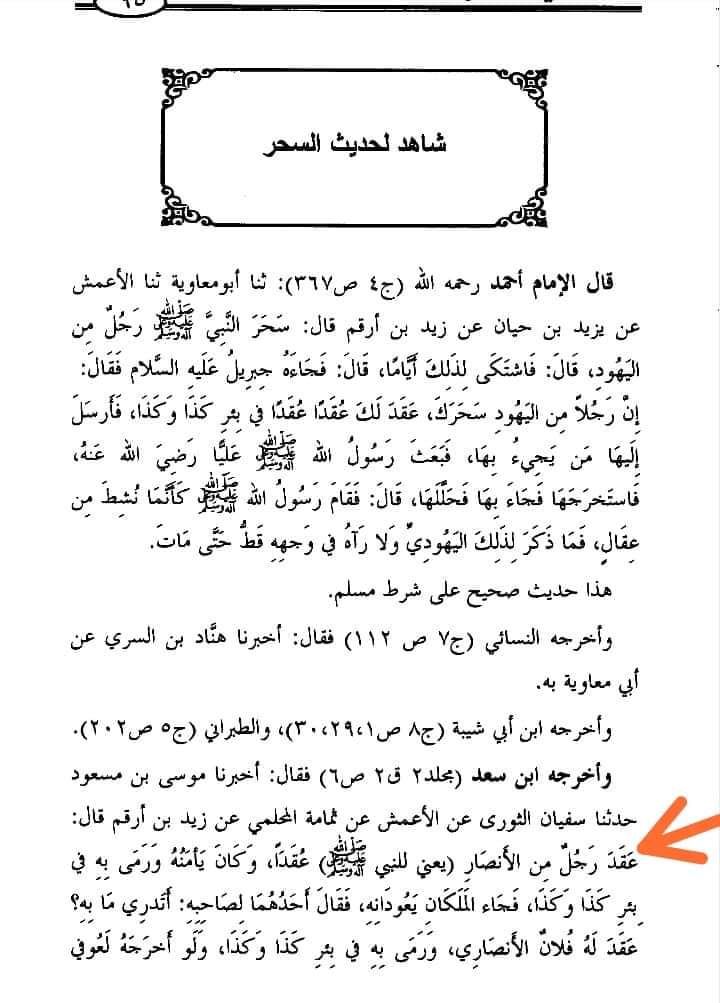
18: There is a book written by a Yemeni Salafi scholar, Sheikh Muqbil Waadii’ in which he tries to defend the Prophet was enchanted with the common reasons that have been discussed earlier in this article. Even in this his book, he also cited an authenticated hadeeth which says the Prophet was not enchanted by a jew but rather an Ansari man(screenshot of the page attached).
Which means if we go by the authentic hadeeth which says he was enchanted by an Ansaar, it still denote that he was enchanted in Madeenah and not in makkah. The preponderant view is that it happened in medina and if we are to agree by this, this incidence cannot be the sabab Nuzool for Falaq and Naas.
19: Another authentic hadeeth established the sabab wuruud of the hadeeth
بسم الله أقيك الله يشفيك من كل شي يؤذيك..
As the same sabab they used in establishing this hadeeth of Labeed.
The hadeeth of ruqyah(Bismillah arqeeka…)was said to be when jubril and another angel came to heal the Prophet and that was the prayer said. It was said he had severe fever which was not up to a day and not a sihr.
A critical study will reveal several interesting contradictions but some scholars of hadith are only obsessed with chains.
In the book of Sh. Muqbil, he quoted Ibn Kethir for saying the popular view is that the sorcerer was a jew and not an Ansari.
And the Ibn kethir conclusion is very vague and Muqbil only qouted him blindly to escape the consequence, the Isnad stating an Ansar man is very authentic and the claim of Ibn kethir that Labid is what is Mash’ur (popular) testifies that the authenticity of Isnad of Ahad narration does not suffice, why do they want to reject an authentic Isnad mentioning an Ansar- it is because they wanted to protect the religiosity of Ansars, but why not that of the Prophet which is even more important?
Don’t you see that Ibn kethir used the term Mashu’ur which is an inferior status to mutawaatir to reject a similarly authentic “Ahad” of an Ansar man. So in simple historical report, he never hesitate to reject a narrator why then would they blame those who sought to reject Ahad which has negative implication on Aqeedah and exalted status of the Prophet!
20: Another argument may say how many mutawaatir do we have to establish hundreds of aqeedah issues? The straight answers to this are: there is no dispute among Scholars on what constitute mutawaatir so you hardly see them disputing over mutawatir or Ahad status of an hadith, rather the dispute is on the suitability of what was agreed as Ahad in establishing Aqeedah. And ahadeeth which are not even up to the level of mutawaatir can be strengthen with Quranic verses or known fundamental of the deen
All the arguments about what constitutes mutawaatir, 10,40,70 or certain numbers of narrators are just theoretical but in practical application there is no dispute, the bone of contention is in negative implication of a supposedly authentic chain which is an variance with an establish norm in Aqeedah or even Ahkam. They all do not dispute about Ahad which is strengthened by an established norm of the Deen.
The mistake we make at times is confusing theoretical academic dispute with its applied implication.
CONCLUSION
There are still some other arguments they devised to justify the enchantment of the Prophet. But individual is at liberty to abide by his conviction and not abiding by theirs can never mean deviancy.
So people should not be threatened with labelling and blackmails for ordinary ahad issues calling them Ahl Hawa, Zindiq, Ahl Bidiah, etc. We have passed the era of forcing people to believe the opinion of a particular group or scholar said to only represent the correct creed. There is truth and falsehood in every tendencies.
We need to thread soft of declaring some stances the most correct or the only correct. As you can prove yours to be correct so I can prove mine. That is why I said I did not oblige anyone to go with my own justification as I see it as non issue. I do not encourage anyone to to be inquisitive about my view. But never should anyone blackmail or brand others on the account of this issue. It is unhealthy.
Some of the reasons for which later scholars brand themselves was in existence during the time of the sahabah and they never branded themselves. Why wasn’t Aa’ishah branded a Mu’tazilite by fellow companions for rejecting the hadith of Abu Hurairah using Quranic evidence? So branding at times is tool used by adversaries to weaken the truth with adversaries.
Most scholars are product of the religious persuasion of their environment or personal conviction and as such principles are just secondary tools used to justify the convictions, so the same principle they have applauded could be easily discarded if its result contradicts their conviction.
Usually, later generation copy from the earlier, so if mistakes occur from the early, it is inherited as such by the later.
Imam Hakim as well consider the hadith of Sihr to be shaz, despite admitting it is in Sahih.
The person who is strongly obsessed with just about chain would hesitate to consider the far reaching implication of the Hadith.
Some are definitely knowledgeable-bodied about Uloomu-l-hadeeth but bereft fiqhul hadeeth.
Imam Bukhari himself does not impose Ahad hadith on creedal issues.
There is difference in talking about chain and a far reaching implication of the same Hadith.
Anyone can stick with the popular view, as for me just leave me with my problem as it is also the problem of other astute scholars like Imam Jasas, Sheikh Rashid Rida, Sheikh of salafiyah Imam Jamaldeen Qasimi, Imam Ibn Ashur and several others. I prefer discussing issues than personalities.
May Allah grant us understanding.
28th January, 2020.
One Response
A very reasonable and balanced piece. Sometimes I wonder why some are hell bent proving Prophet was enchanted.